
Before beginning the actual rigging and animating process, I wanted to quickly test my model’s manoeuvrability, so I could determine its animation capabilities. Doing this would allow me to analyse my model’s structure, and envision in advance how I would go about bringing my character to life in the way I intend.
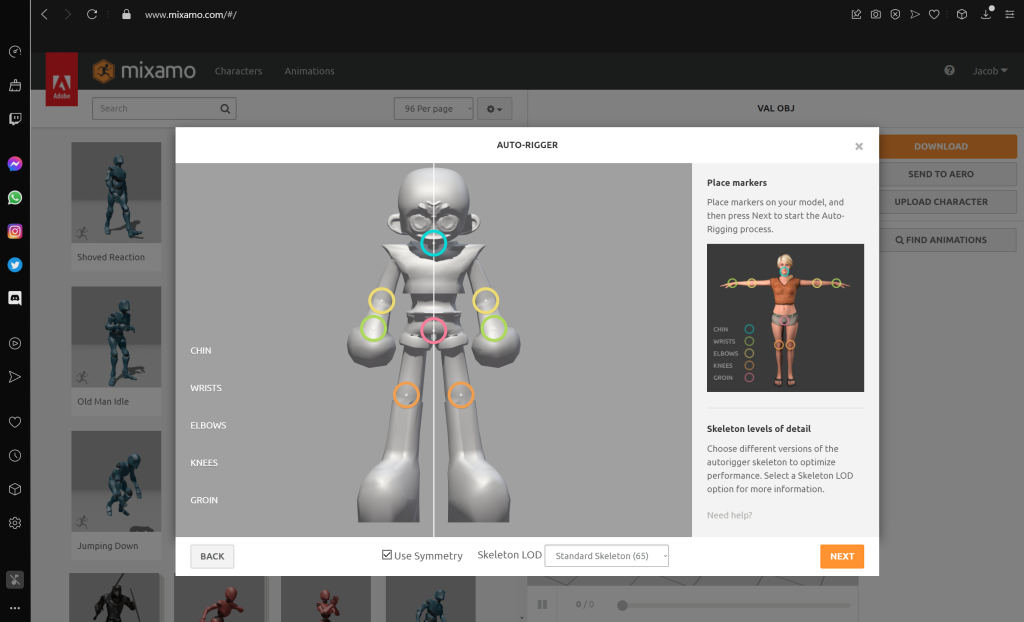
I achieved this by using Adobe’s free web program Mixamo, available at ‘https://www.mixamo.com/’. It is designed to give 3D animators the ability to prototype how a character model may be animated through the use of pre-created animations that can be automatically applied to any uploaded ‘.obj’ file.
To begin this process, Mixamo’s auto-rigger allowed me to easily create a rudimentary temporary rig for my character model, for the purpose of demoing potential animations, through the use of draggable markers placed onto different body parts.
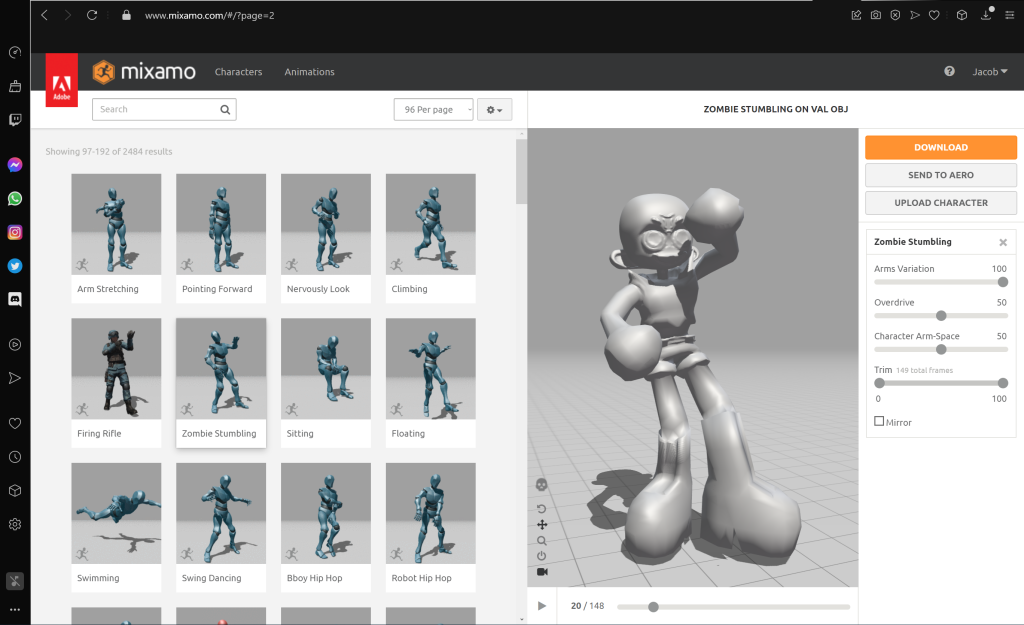
Mixamo is a great tool for the purpose of demoing potential animations. On the left, one can select a variety of test character animations from an extensive collection, and apply them to your original uploaded character model. The menu to the right allows you to tweak the animation in a variety of ways, for instance manipulating the ‘Character Arm-Space’ slider changes how far apart the model’s arms are from each other, and the ‘Overdrive’ slider controls how extreme and exaggerated the movements of the entire animation are.
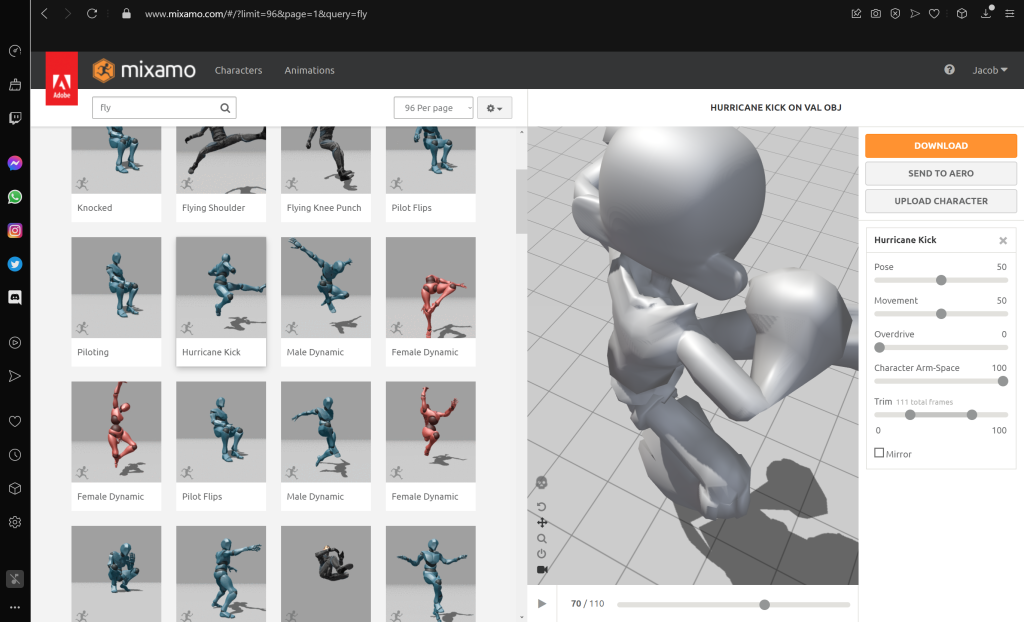
Through testing a large number of animations, I was able to detect if there were any issues with the topology of the model that lead to unnatural body/limb flexion. An example of this occurring can be seen above with Val’s arms which, when specifically performing the ‘Hurricane Kick’ animation, bent in a non-natural manner (this did not occur in other animations regardless of similarities). Even though the design of my character Val is not supposed to mimic the natural laws of physics and anatomy typically applied to more human-esque characters due to my stylistic choicing and character narrative design, this bending in the arm still looks off from the perspective of being a physical object with density and internals. Therefore, this testing proved useful, as I am now aware of what types of animations I should avoid, and what areas require the most weight-painting.
Notice the feet rotating and snapping back into place in the animation above. Certain animations I applied to my Val model did not have a problem with limb distortion, yet they still bent in a very unnatural manner due to the way the auto-rig was set up in conjunction with the cartoonish proportions of my character, as seen in this one. My intention is to make my character move very quickly, robustly and inhumanely, and I do not want much bending of the feet/ankles to show the robustness and sturdiness of the character, so this hopefully shouldn’t be an issue when animating, but I will still look out for it.
The use of Mixamo has helped tremendously with furthering my understanding of 3D animation, pure animation itself, and even the workings of just 3D models to a further degree than what I learned during the 3D Character Modelling assignment