Prior to beginning this module, I had not actually been exposed to any form of the Alice’s Adventures in Wonderland story, and my understanding of it was limited to external discussion and 3rd party references in media. Therefore, I decided to take a look at both the original 1865 book by Lewis Carroll and the 1951 animated film adaptation by Walt Disney Productions in preparation for this module.
Whilst contemplating this story, my mind was instantly drawn to a very specific popular figure of an internet subculture, as, in my opinion, their circumstances and life story are strangely irr/mm ent. Known simply by the online-persona ‘Ironmouse’, she has risen from highly unfortunate circumstances to becoming the most popular female livestreamer and ‘VTuber’ ever, and her tremendous journey has inspired my take on the story for my VR experience.
A look at Ironmouse:
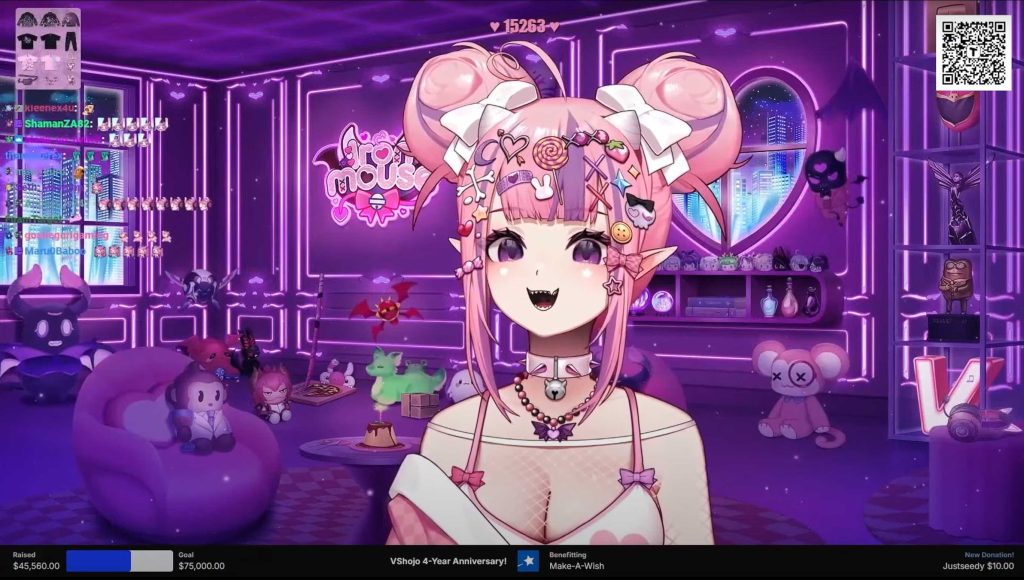
I have been a viewer and fan of Ironmouse (real name unknown) and her internet content for quite some time now, and found out about her disability through her numerous discussions around the subject on her many livestreams. She suffers from CVID – Common Variable Immunodeficiency, a debilitating illness that brings her many difficulties in life. CVID primarily causes a harshly weakened immune system, meaning that external bacteria and viruses can be much more deadly to the recipient’s compromised body. Related circumstances include general illness being much more common of an occurrence, and medication being delivered via a ‘port’ implanted through the chest. This illness causes her to be unable to leave her house or closely physically interact with other people, as even the smallest form of illness passed on to her can be lethal.
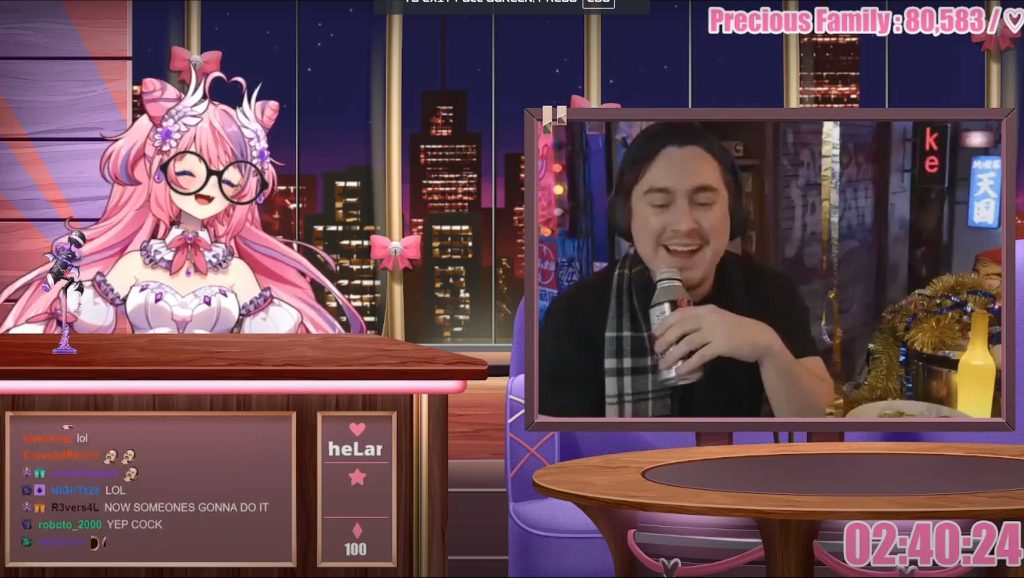
Numerous times during livestreams (and YouTube videos of condensed versions of said livestreams), Ironmouse has discussed these issues she faces, how becoming a streamer/VTuber has helped as a form of escapism, and how she feels like she isn’t living as lonely and limited of a life during livestreams. Being a VTuber for livestreaming is a big part of this, as with VTubing one does not have to use your real face or identity when presenting oneself to an audience, and instead, an illustrated character that reacts in real-time to tracked body movements and audio inputs presents the illusion of a fictional character to the audience. Sure, Ironmouse breaks the illusion by explaining matters from her real life like her health issues and her country/culture of origin, in her case being Puerto Rican, but the majority of the time she is known as a pink-haired demon who is thousands of years old, complete with lore and a fictional place of origin. She has stated that engaging in this persona allows her something greater in life than the reality she lives in otherwise, and acts as both a coping mechanism and a job (which is one of the only kinds of jobs she can actually do). Becoming a streamer and VTuber has allowed her to accomplish many things she otherwise wouldn’t have been able to, like launch a singing career, host a VTuber and streamer focused talk show, and raise money through large-scale charity events with her online friends for the Immune Deficiency Foundation, an organisation that provides aid to immunocompromised individuals, whom have helped Ironmouse in the past amongst many others.
In the video below, Ironmouse discusses her illness and experiences surrounding it with a representative from the Immune Deficiency Foundation:
My adaptation:
It is commonly agreed that a theme of the original story is escapism. In Alice’s case, the escapism is felt by her purely because she is literally escaping from her regular life into an entirely new world. However, also in Alice’s case, she isn’t escaping anything necessarily negative, per se, at least to the knowledge of the reader. Alice lives a rich and plentiful life, and whilst it may be interpreted as an unfulfilling life for her, she doesn’t come from a place of hardship. In my adaptation, I would present the theming of escapism directly in relation to hardship and struggle inspired by Ironmouse and others in a similar situation to her. I intend it to portray the isolated existence of physically ill people, and thusly follow the escapism of the subject via transition to Wonderland, which in my adaptation will represent the world of digital and online social environments, how it can often feel like a tangible, literal location many people/users can visit (just like metaverses), and how the internet and VTubing allows the user to feel and present themselves via an entirely new entity.
I’ve decided to make my adaptation this way because I believe it will be interesting and important to explore the points of view of more unique cases of the human experience that aren’t lived by the average person. Additionally, I feel like my narrative adds a layer of depth that the original story, in my opinion, lacks. Alice in Wonderland famously doesn’t have as great of a point or message within the backbone of the story, aside from facilitating randomness and wonder. Whilst I don’t believe that the original story necessarily needed an extra layer of depth, the simplicity of the narrative allows for added additional context in adaptations without being too disassociated from the original story’s identity.
References:
– [link here]